


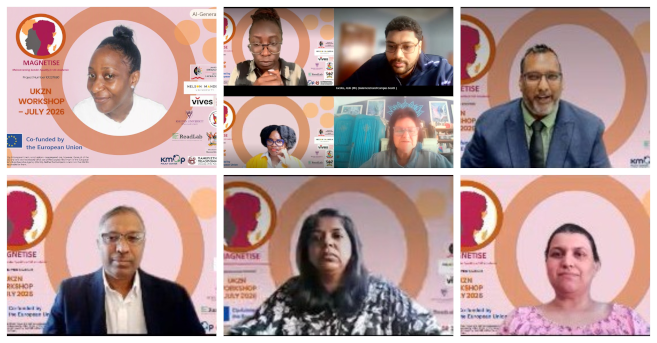
The University of KwaZulu-Natal (UKZN) hosted the international MAGNETISE workshop recently, ‘Embedding Gender Equality: Aligning Policy with Practice’, bringing together 94 delegates from Rhodes University, Nelson Mandela University and UKZN in South Africa, and Muni University and Makerere University in Uganda.
MAGNETISE is an Erasmus+ Strand 2 project supporting five sub-Saharan African institutions in designing and embedding Gender Equality Plans (GEPs) in partnership with European counterparts. The virtual workshop provided an opportunity for university staff, management, student representatives, researchers and partners to reflect on existing practices, identify institutional challenges and discuss concrete actions to advance gender equality in Higher Education.
Opening the session, Dr Boby Varghese, Head of the Centre for Academic Success in Science and Engineering in the College of Agriculture, Engineering and Science (CAES) and MAGNETISE Project Coordinator, invoked the African proverb “if you want to go far, go together,” setting the tone for a morning of shared learning.
Professor Naven Chetty, CAES Dean of Teaching and Learning, presented UKZN’s institutional gender data, noting that female student participation stands at around 63%, with strong gains in Agriculture, Engineering and Science, and Health Sciences. However, several ‘scarce skills’ fields, including engineering, information and communications technology (ICT), data science and selected medical specialisations, continue to have low female enrolment. He also presented statistics on staff gender representation at UKZN.
From Classroom to Culture
Dr Antoinette Damant showcased UKZN’s ‘Critical Social Justice and Citizenship’ module, a compulsory, Senate-mandated course for all first-year students that combines pre-recorded lectures, an AI-enhanced reflective tutor and small-group tutorials. Grounded in a ‘politics of hope’, the module seeks to challenge harmful gender socialisation rather than punish it. Dr Damant also highlighted the work of UKZN’s Gender-Based Violence Office, which has reached some 3 700 students and staff through awareness training. Quoting Desmond Tutu, Dr Damant reminded participants: “If you are neutral in situations of injustice, you have chosen the side of the oppressor.”
Voices from the consortium
A panel moderated by CAES Senior Academic Development Officer Dr Sahejna Bantho brought together panellists from Rhodes University, Nelson Mandela University and Muni University. Panellists agreed that quick wins matter less than durable structures. Muni University highlighted the importance of visible senior management support; Rhodes University described GenAct, its gender activist forum, which is now formally constituted as a Senate subcommittee; and Nelson Mandela University demonstrated how enrolment data mapped against school quintiles is used to guide deans towards measurable action. A recurring message was that policy on paper does not necessarily translate into institutional practice. Dr Stella C Sabi and Dr Dalia Varghese of UKZN’s CAES led the feedback, consolidation and next-steps session, as well as the workshop evaluation.
Delegates described the workshop as informative and well-facilitated, praising the rare opportunity to network across institutions and borders. Constructive feedback called for stronger Africanisation and decolonisation framing, sharper attention to hiring and promotion bias, and content better tailored to professional and administrative staff – all of which will be incorporated into UKZN’s Gender Equality Plan.
As MAGNETISE partners move toward finalising their Gender Equality Plans, the workshop reinforced a central message: sustainable transformation depends on institutions working together and, in the words of the opening proverb, going far by going together.
Words: NdabaOnline
Images: Supplied